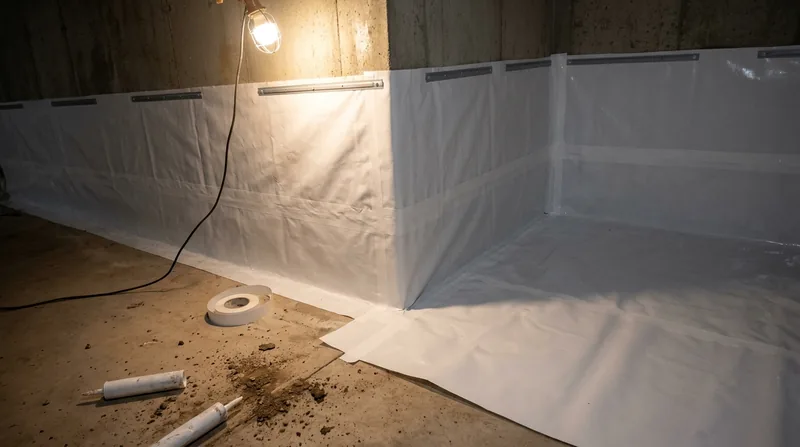




If your Aurora basement smells musty by August or the block walls sweat through every humid week, the problem is usually moisture vapor moving through the concrete, not a visible leak. Vapor Barrier Installation in Aurora puts a heavy-duty barrier across the walls and slab to stop that ground moisture before it reaches your stored boxes, framing, and finished space. Aurora sits on flat glacial clay plains above a high water table, and the Fox River corridor pushes damp air into full basements across the Near Westside, Pigeon Hill, and the Far East Side subdivisions. We install sealed, taped, sump-integrated barrier systems built for Fox Valley freeze-thaw and cloudburst summers. Start with a free basement inspection so we can measure the actual moisture load before quoting a barrier.
Why Vapor Barrier Installation Matters in Aurora's Clay-Soil Basements
Aurora's housing stock fights vapor differently than most towns. The 1860s to 1910s Victorians and Italianates on cut limestone and brick foundations near Tanner and the historic districts pull damp straight through porous mortar. The 1910s to 1940s brick bungalows and foursquares on full basements, plus the 1950s and 1960s brick ranches on concrete block, wick groundwater up from the footing. Newer 1990s to 2020s poured-concrete basements on the Far East Side and in Naperville and Oswego subdivisions still see slab vapor drive when the water table rises after spring snowmelt or a July cloudburst like the 1996 storm that dropped about 17 inches on the city.
- Efflorescence and white salt bloom on block walls tells you moisture is moving through the masonry, not just condensing on it.
- A musty basement smell that returns after every rain points to vapor load, not a single crack.
- Damp drywall, rusted fasteners, and curling cardboard are early signs the slab and wall vapor is uncontrolled.
- Homes with a failing sump pump or no check valve push more humidity back into the basement air.
Sealing the walls and slab with a proper barrier handles the vapor side, while a full basement waterproofing plan handles the liquid water side.
Key info: On a 1920s foursquare near Riddle Highlands, we found efflorescence halfway up a block wall and a wet slab, with no active crack leaking. The fix was a wall and slab vapor barrier tied into the existing sump basin, not excavation.
Before any barrier work, confirm what your local building department requires for work that alters drainage or sump discharge routing. Start with the City of Aurora building department; thresholds vary by jurisdiction and must be verified for your address.
How We Install Vapor Barriers in Aurora Homes
We treat vapor barrier installation as a below-grade system, not a plastic sheet taped to a wall. The crew evaluates wall material, slab condition, sump location, and how the foundation drains, then builds the barrier to shed any liquid water toward the sump while blocking vapor. On limestone and brick foundations we prep the surface first so the barrier sits flat and the seams hold through freeze-thaw cycling.
- We inspect the basement, slab, and wall joints and map where moisture is actually entering.
- We prep the walls and slab, removing loose parging and patching obvious defects before any sheet goes up.
- We install heavy-duty barrier sheets across the walls and slab with overlapping seams and taped terminations.
- We integrate the barrier with the sump basin and check valve so liquid water has a path out.
- We seal penetrations, pipe entries, and the wall-to-slab cove, then verify the system before we leave.
If the inspection shows active hydrostatic pressure or a failed drain tile, we tell you plainly that a barrier alone will not solve it and point to the right repair.
Key info: A 1960s split-level in Montgomery had a damp slab and a sump that ran constantly after storms. We tied the new barrier into a sump pump installation with a check valve, and the basement stayed dry through the next spring melt.
| Approach | Description | Best for |
|---|---|---|
| Wall and slab vapor barrier | Heavy-duty sheets across walls and slab with sealed seams and taped terminations. | Musty basements with efflorescence and no active leak. |
| Barrier with sump integration | Barrier tied into the sump basin, check valve, and discharge line. | Basements where the water table rises fast after storms. |
| Barrier over dimple board | Drainage mat behind the barrier to relieve hydrostatic pressure at the wall. | Block walls with damp mortar and heavy vapor drive. |
| Spot barrier repair and reseal | Replacing failed sections, resealing seams, and re-taping terminations. | Existing barriers with peeling or open seams. |
Vapor Barrier Installation Cost in Aurora: What to Expect
Most Aurora vapor barrier projects start from $3 per square foot of treated wall and slab area, and the final number depends on how much prep the foundation needs. A clean poured-concrete wall on the Far East Side prices near the low end. A limestone or brick foundation in the historic districts, where we have to remove loose parging and level the surface, moves up. Sump integration, dimple board, and the length of wall and slab being covered all shift the figure.
We recommend two or three written estimates on any below-grade work so you can compare scope, not just the bottom line. Ask each contractor what prep is included, whether sump integration is in the bid, and what warranty transfers with the home. Our full pricing overview shows how the line items break down before you call.
Finding a Vapor Barrier Installation Contractor Near Me in Aurora
Hiring for below-grade work near Aurora means checking more than a truck and a phone number. Ask for proof of licensing and insurance, and request a certificate of coverage before work starts. Get at least two or three estimates in writing, and ask each contractor for local references on homes built like yours, whether that is a Victorian on cut limestone or a 1990s two-story on poured concrete. Understand what permits the local building department requires, especially if the job alters sump discharge or drainage routing. If you live in an HOA subdivision in Montgomery or Sugar Grove, confirm any exterior discharge or grading rules before the crew arrives.
We are a Basement Health Association member and a dedicated basement waterproofing specialist, not a general foundation firm or a plumber. Call our contact page to book a free inspection and get a straight answer on whether a barrier is the right fix.
Vapor Barrier Installation in Aurora: Pricing Guide
| Service | Price | Details |
|---|---|---|
| Wall and slab vapor barrier | Starting at $3/sq ft | Includes surface prep, heavy-duty sheets, sealed seams, and taped terminations on walls and slab. |
| Barrier with sump integration | Starting at $4/sq ft | Adds sump basin tie-in, check valve, and discharge routing; price rises with line length and pump work. |
| Barrier over dimple board | Starting at $5/sq ft | Includes drainage mat behind the barrier to relieve hydrostatic pressure on damp block walls. |
| Spot barrier repair and reseal | On estimate | Replacing failed sections and resealing seams needs an on-site look to price accurately. |
| Travel | Included | In Aurora and surrounding Fox Valley areas, no separate call-out or mileage fee. |
| Estimate | Free | Response within 24h at (331) 210-0522, no obligation to book. |
Indicative pricing, the exact cost depends on square footage, finish, and site access. Free personalized estimate within 24h at (331) 210-0522.


