



French Drain Installation in Aurora: Stop Groundwater Before It Reaches Your Foundation
If you own a home in Aurora, you already know the Fox River and the flat glacial clay plains it sits on. That clay holds water like a bowl after every summer cloudburst, and the high water table pushes it right against your foundation. French Drain Installation in Aurora is the most direct way to intercept that groundwater before it ever touches your basement wall, and we install these systems on Victorian limestone foundations in Tanner, on 1950s brick ranches across the east side, and on deep poured-concrete basements in the Far East Side subdivisions. We do one thing: below-grade water control. You can see how this fits with the rest of our basement waterproofing work, and if your basement is already wet, we will tell you plainly whether a French drain is the right fix or whether the real problem is hydrostatic pressure that needs an interior drain tile system instead.
Why French Drain Installation Matters on Aurora's Glacial Clay and Fox River Floodplain
Aurora sits on flat former farmland and old creek beds that rise fast during spring snowmelt and the hard freeze-thaw cycles of January and February. The July 1996 storm that dropped about 17 inches of rain on the city is still the benchmark local homeowners use when they talk about a wet basement. On lots from North Aurora and Montgomery through Oswego and Plainfield subdivisions, water pools against the house because the clay does not drain and the grading is too flat to move it. A French drain intercepts that water in the soil, not inside your basement.
- You see standing water or saturated soil along the foundation after every heavy rain.
- Your downspouts discharge close to the wall and the ground stays soft for days.
- Efflorescence appears on the lower block or brick, a sign of moisture moving through the wall.
- The sump pump runs long after the rain stops, which points to water still feeding the footing drain.
- Your lot is flat or slopes toward the house, so surface water has nowhere to go.
If any of those describe your place, the drain is usually the first line of defense, and a simple crack seal will not fix a grading and soil problem.
Key info: On the flat lots in North Aurora and Montgomery, we often find downspouts dumping within 18 inches of the foundation. Extending them and installing a French drain along the wet side of the house is frequently the difference between a dry basement and a sump pump that runs all spring.
Before any excavation, check what your local building department requires, because rules vary by jurisdiction and must be verified. The City of Aurora's building permit information is a good starting point: City of Aurora, Illinois official site.
How We Install a French Drain Along an Aurora Foundation
We start by walking the lot and reading the water. That means checking the grading, the downspout locations, the soil type, and where the water actually ponds after a storm. On cut limestone and brick foundations in the Near Westside historic district, we hand-dig near the wall to avoid damaging the original footing. On the deep poured basements on the Far East Side, we can move faster with a trencher, but we still verify the footing drain and the sump basin before we tie anything in.
- We mark the trench line and confirm the discharge point, either daylight on a slope or a sump basin.
- We excavate to the footing, keeping the trench wide enough for gravel and fabric wrap.
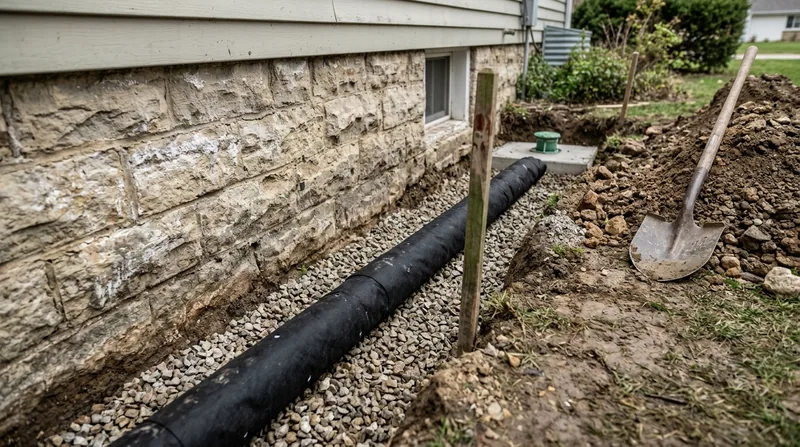
- We lay filter fabric, then graded gravel, then the perforated pipe with the holes facing down.
- We wrap the fabric over the gravel to keep glacial clay fines from clogging the pipe.
- We tie the drain to daylight or to the sump basin, and we check the check valve and discharge line.
- We backfill, regrade the soil to slope away from the wall, and test the system with water before we leave.
Every install ends with a water test so you can see the drain working before we pack up.
Key info: On a 1920s brick foursquare near Pigeon Hill, the rear yard sloped toward the house and the downspouts fed a soggy strip along the foundation. We ran a French drain along the rear wall to daylight at the alley, and the basement stayed dry through the next spring melt.
If the water is already inside the basement and the footing drain is failing, an interior drain tile system is often the better answer than exterior excavation, and we will say so.
French Drain Approaches We Use in Aurora
Not every lot needs the same system. The right approach depends on your soil, your grading, and whether you have a sump basin to tie into. Here is how we match the method to the property.
| Approach | Description | Best for |
|---|---|---|
| Exterior footing French drain to daylight | Gravel and perforated pipe along the footing, fabric wrapped, discharging by gravity to a lower point on the lot. | Lots with a slope or an alley outlet, common on Aurora's east and west sides. |
| Exterior French drain tied to sump basin | Same gravel and pipe system, but the discharge runs to the sump basin and pump instead of daylight. | Flat lots in North Aurora, Montgomery, and the Far East Side where gravity drainage is not possible. |
| Surface French drain for yard water | Shallow gravel trench that collects sheet flow and roof water before it reaches the foundation. | Yards that pond after cloudbursts but show no wall seepage yet. |
| Downspout and grading correction with drain | Extended downspouts, regraded soil, and a short drain run along the wettest wall. | Homes where the water source is the roof and the flat grade, not the water table. |
We pick the approach after we see the lot, not before, because the wrong drain on the wrong soil just moves the problem.
French Drain Installation Cost in Aurora: What to Expect
Most French drain work in Aurora starts at From $25 per linear foot, and that figure moves with the length of the run, the depth to the footing, the soil, and the access. A short run along one wet wall on a bungalow is a different job than a full perimeter drain around a deep poured basement on the Far East Side. Hand-digging near a cut limestone foundation in the historic districts takes longer than trenching a flat subdivision lot, and that labor shows up in the number.
Getting two or three estimates is smart because the scope should match the water problem, not a sales target. Ask each contractor to explain where the water goes and why. Our full pricing overview lays out the ranges, and we will tell you when a simpler fix, like extending downspouts and regrading, is enough for now.
What to Look for When Hiring a French Drain Contractor Near Me in Aurora
Hiring for a below-grade drain is not the same as hiring a landscaper. You want a contractor who works on foundations and understands hydrostatic pressure, drain tile, and sump discharge, not someone who digs a trench and disappears. Ask for proof of licensing and insurance, and ask what happens if the drain clogs or the discharge line freezes.
- Confirm the contractor is licensed and insured, and ask for a certificate before work starts.
- Get at least two or three written estimates with the scope spelled out.
- Ask for local references, especially on streets with the same soil and grading as yours.
- Ask who pulls the permit if the work alters drainage or the sump discharge connection.
- Check HOA rules before you dig, since some subdivisions restrict where discharge can go.
If a contractor cannot explain where the water will discharge, keep looking. You can reach us through our contact page for a straight answer on your lot.
Key info: Aurora Waterproofing is a Basement Health Association (BHA) member, and we specialize in below-grade water control only. That focus is why we can tell you when a French drain is the right call and when an interior system or a crack repair is the honest answer.
French Drain Installation in Aurora: Pricing Guide
| Service | Price | Details |
|---|---|---|
| French drain along one wall | Starting at $25/linear ft | Includes excavation, filter fabric, graded gravel, perforated pipe, and backfill on a single wet wall. |
| Full perimeter French drain | Starting at $25/linear ft | Full loop around the foundation, priced by total length, depth to footing, and discharge method. |
| Drain tied to sump basin | On estimate | Requires a sump basin and pump tie-in, so we inspect the existing basin and discharge line first. |
| Historic or hand-dig foundation | On estimate | Cut limestone and brick foundations in the historic districts need careful hand digging near the footing. |
| Travel | Included | In Aurora and surrounding Fox Valley towns, with no separate call-out or mileage fee. |
| Estimate | Free | Response within 24 hours at (331) 210-0522, with no obligation to book the work. |
Indicative pricing, the exact cost depends on square footage, finish, and site access. Free personalized estimate within 24h at (331) 210-0522.


