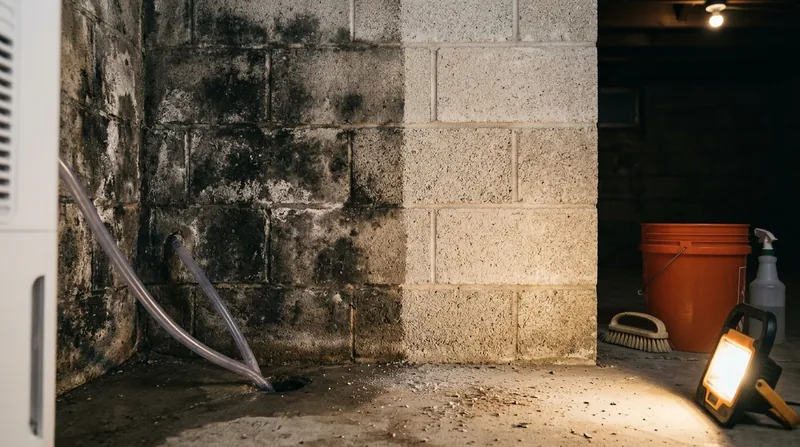




Basement Mold Remediation in Aurora
When you search for Basement Mold Remediation in Aurora, you are usually standing in a basement that smells like wet earth and old cardboard. Aurora sits on flat glacial clay plains along the Fox River, and that clay holds water like a bowl. Add a high water table, heavy summer cloudbursts, and spring snowmelt, and the musty smell in a Tanner historic district Victorian or a 1950s brick ranch on the east side is rarely a mystery. It is a moisture problem that has been running quietly for months. We fix the moisture source first, then treat the affected surfaces, so the mold does not simply return with the next rain. If you want the full picture of how we keep water out, start with our basement waterproofing in Aurora page.
Why Basement Mold Remediation Matters So Much in Aurora's Older Housing Stock
Aurora has an unusual mix of basement construction, and each type fails differently. The 1860s to 1910s Italianate and Queen Anne homes in Near Westside and Riddle Highlands often sit on cut limestone or brick foundations from the Fox Valley quarries. Those mortar joints weep, the rubble cores hold water, and efflorescence blooms white on the walls every spring. The 1910s to 1940s brick bungalows and foursquares on full basements have the same issue at the cove joint, where the wall meets the floor. Out on the Far East Side, deep poured-concrete basements in 1990s to 2020s two-story homes are tighter, but they still sweat in humid Illinois summers and grow mold on framing and stored goods after a sump pump failure.
- Limestone and brick foundations in the historic districts wick groundwater upward and stay damp long after the rain stops.
- Concrete block basements across the east and west sides pull water into the hollow cores and release it into the room.
- Poured-wall homes in North Aurora and Montgomery grow surface mold when relative humidity stays above 60 percent for weeks.
- Homes near creeks and former wetlands in Oswego and Plainfield flood fast because the clay cannot absorb a sudden downpour.
In every one of these cases, the mold is the symptom. The moisture is the cause, and that is what we chase down first.
Key info: After the July 1996 storm dropped roughly 17 inches of rain on Aurora, basements across the Near Westside filled faster than sump pumps could discharge. Homes that stayed dry had working drain tile and a pump with a functioning check valve. Homes that did not were dealing with mold for the rest of that summer.
For official guidance on moisture and mold in buildings, the U.S. Environmental Protection Agency publishes a plain-language resource at epa.gov/mold that is worth reading before you decide how far the problem has spread.
How We Run a Basement Mold Remediation in Aurora, Step by Step
We do not start with a sprayer. We start with a moisture diagnosis, because treating mold without finding the water source is a waste of your money. We check the cove joint, the wall base, the floor drains, the sump basin, and the rim area for signs of seepage. We read the hygrometer, look for efflorescence, and trace the musty smell back to its source. Then we build a scope that matches what we actually found.
- We set up containment with plastic sheeting and negative air pressure so spores do not migrate into the rest of the house during work.
- We remove and bag porous materials that cannot be saved, such as wet drywall, carpet, and cardboard storage.
- We HEPA-vacuum and treat affected framing, block, and concrete with an antimicrobial application rated for basement surfaces.
- We correct the moisture path, whether that means sealing a wall, extending a downspout, repairing drain tile, or adding a dehumidifier sized for the space.
- We verify with a moisture meter and a visual walkthrough before we pull the containment down.
The moisture correction step is where most of the value sits, and it is the step fly-by-night mold sprayers skip.
Key info: A bungalow on Pigeon Hill had mold climbing four feet up a block wall and a musty smell in the back bedroom. The cause was a clogged footing drain and a discharge line that dumped water two feet from the foundation. We cleared the drain, extended the discharge, treated the wall, and the smell was gone within a week. If the drainage had been left alone, the mold would have been back by August.
When the diagnosis points to a perimeter drainage problem rather than a surface issue, the right next step is usually an interior drain tile system in Aurora, which captures water at the cove joint before it ever reaches your stored goods.
Remediation Approaches We Use in Aurora Basements
No two basements here get the same treatment plan. A limestone foundation in a historic district needs a different approach than a poured wall in a 2015 subdivision. The table below shows the main approaches we use and where each one fits.
| Approach | Description | Best for |
|---|---|---|
| Surface treatment and HEPA cleanup | Containment, HEPA vacuuming, and antimicrobial application on affected block, concrete, and framing. | Light surface mold on walls and joists with a known, correctable moisture source. |
| Material removal and rebuild | Cutting out wet drywall, insulation, and carpet, then drying the structure before any rebuild. | Finished basements where water soaked behind drywall after a sump failure or wall seepage. |
| Moisture source correction | Crack injection, wall sealing, drain tile repair, downspout extension, or grading correction. | Recurring mold after rain, which means water is still entering the basement. |
| Humidity control | Sizing and installing a dehumidifier and sealing obvious air leaks in humid summer months. | Tight poured basements that sweat in July and August without any visible leak. |
| Vapor barrier and wall sealing | Dimple board or vapor barrier against the wall plus a sealed cove joint to stop vapor drive. | Damp block walls that stay wet to the touch and bloom with efflorescence each spring. |
We choose the lightest approach that actually solves the problem, and we tell you when simple crack sealing is enough instead of pushing a full drainage system.
Basement Mold Remediation Cost in Aurora: What to Expect
Most basement mold remediation jobs in Aurora start around $1,500, and that figure covers containment, HEPA cleanup, treatment of affected surfaces, and a moisture diagnosis. From there, the number moves with the size of the affected area, how much material has to be cut out, and whether the moisture source needs drainage work. A small patch on a block wall in a Montgomery ranch is a different job than a finished basement in Naperville that took on water after a sump pump failure.
Three things drive the price more than anything else: square footage of affected surface, whether the framing or drywall has to be opened up, and whether we are correcting a drainage problem at the same time. We give you the moisture fix as a separate line so you can see exactly what the remediation costs on its own. Get two or three written estimates and compare scope, not just the bottom line. A cheap spray-and-walk quote that leaves the water path open will cost you twice. Our full pricing overview breaks down how we structure estimates.
Basement Mold Remediation Near Me: How to Vet a Contractor Around Aurora
Anyone with a sprayer and a truck can call themselves a mold remediator. The difference between a real remediation and a cosmetic cover-up shows up six months later when the smell returns. Here is what to check before you sign anything.
- Ask for proof of liability insurance and workers compensation coverage, and request a certificate be sent to you directly.
- Get at least two or three written estimates that itemize containment, removal, treatment, and moisture correction separately.
- Ask for local references from Aurora, North Aurora, or Batavia basements similar to yours, and call them.
- Confirm who pulls permits if the scope touches structural repair or alters a sump discharge connection, since rules vary by jurisdiction.
- Ask how they verify the work is dry at the end, because a moisture meter reading is the only proof that matters.
Aurora Waterproofing is a member of the Basement Health Association, and we are happy to walk you through our credentials before you commit. Reach out through our contact page to schedule a free basement inspection and get a straight answer about what your basement actually needs.
Basement Mold Remediation in Aurora: Pricing Guide
| Service | Price | Details |
|---|---|---|
| Surface mold treatment with HEPA cleanup | Starting at $1,500 | Includes containment, HEPA vacuuming, antimicrobial treatment, and moisture diagnosis for a limited affected area. |
| Finished basement remediation with material removal | Starting at $2,800 | Covers cutting out wet drywall and insulation, drying the structure, and treating exposed framing and block. |
| Remediation plus moisture source correction | On estimate | Priced after inspection because drainage, crack injection, or wall sealing scope varies house to house. |
| Travel | Included | In Aurora and surrounding Fox Valley towns, with no separate call-out or mileage fee. |
| Estimate | Free | Response within 24 hours at (331) 210-0522, with no obligation to book the work. |
Indicative pricing, the exact cost depends on square footage, finish, and site access. Free personalized estimate within 24h at (331) 210-0522.


