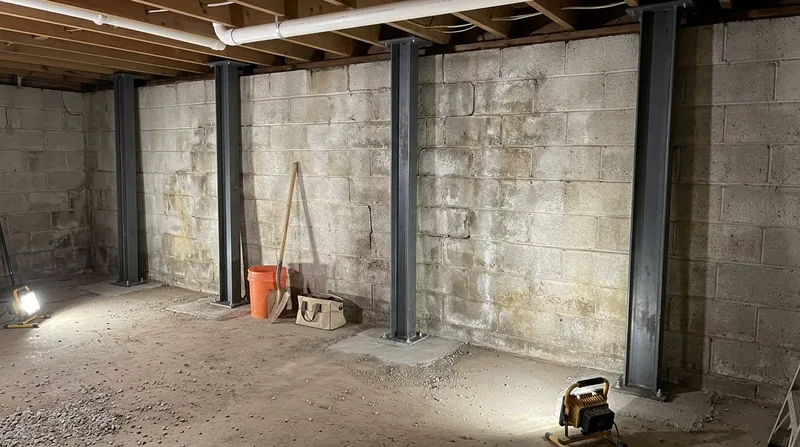




Aurora sits on flat glacial clay plains along the Fox River, and that heavy, slow-draining soil pushes hard against residential foundation walls every spring. Homes in the Tanner and Near Westside historic districts, on Riddle Highlands and Pigeon Hill, and the 1950s-1960s brick ranches on the east and west sides all share the same weak point: saturated clay, freeze-thaw cycles, and hydrostatic pressure that bows walls inward. If you are searching for Bowing Wall Repair in Aurora, the wall has already moved past simple crack sealing, and the fix has to address the load, not just the crack. We install carbon fiber straps, steel I-beams, and wall anchors matched to your wall material and soil conditions. Call (331) 210-0522 to schedule a free basement inspection and get a straight answer on whether your wall needs stabilization or monitoring. Start with our foundation crack repair page if you also see seepage along the wall.
Why Bowing Walls Are So Common in Aurora's Clay Soil
Aurora's building stock tells the story. Victorian and Italianate homes on cut limestone and brick foundations from Fox Valley quarries have had 120-plus years of wet winters. The 1950s-1960s brick ranches and split-levels on concrete block basements are the most frequent bowing wall calls we get, because block walls resist lateral load poorly once the clay behind them stays saturated. The July 1996 storm that dropped about 17 inches of rain on Aurora is still the benchmark for how fast the water table can rise here.
- Hydrostatic pressure builds when glacial clay soil cannot drain and pushes inward against the wall.
- Freeze-thaw cycles expand saturated soil in winter and crack mortar joints in block walls.
- Deteriorated drain tile and clogged footing drains let water sit against the foundation instead of carrying it away.
- Downspout and grading problems dump roof water at the wall base, which is the fastest way to accelerate movement.
- Tree roots from mature oaks and maples can lift soil and create voids that shift lateral pressure.
Any one of these can start a wall moving, and two or three together usually explain why a wall that looked fine last year is now visibly bowed.
Key info: A block basement wall on Aurora's west side that bows more than 1 inch over 8 feet is a structural concern, not a cosmetic one. We measure the deflection and check for horizontal cracking at mid-wall before recommending a repair method.
For the official position on structural repair permits in Aurora, check the City of Aurora building department before work begins.
How We Repair a Bowing Wall in Aurora, Step by Step
We start by finding out why the wall moved. That means checking the wall material (limestone, brick, concrete block, or poured concrete), measuring deflection, inspecting the drain tile and sump basin, and looking at grading and downspout discharge. A carbon fiber strap job on a 1960s block wall in Montgomery is a different scope than steel I-beams on a deep poured basement on Aurora's Far East Side, and the soil tells us which way to go.
- We excavate or open the interior as needed and expose the wall face for a full inspection.
- We measure the bow at multiple points and map horizontal cracking and mortar deterioration.
- We correct the water source first, because stabilizing a wall while clay stays saturated is a temporary fix.
- We install carbon fiber straps, steel I-beams, or wall anchors based on deflection, wall type, and soil load.
- We seal penetrations and restore the wall finish, then verify the repair with a follow-up measurement.
The right method depends on severity, and we tell you plainly when monitoring is enough and when stabilization is required.
Key info: On a 1958 brick ranch near the Fox River in North Aurora, we found 1.5 inches of deflection at mid-wall and a failed footing drain. We installed carbon fiber straps across the interior face and tied the repair to a new interior perimeter drain so the clay behind the wall could finally release water.
If the water source is the real problem, our interior drain tile system page explains how we relieve pressure before and after stabilization.
Bowing Wall Repair Methods We Use
We match the method to the wall, the deflection, and the soil load. Here is how the main approaches compare for Aurora homes.
| Approach | Description | Best for |
|---|---|---|
| Carbon fiber straps | Epoxy-bonded straps across the interior wall face that resist further inward movement. | Block or poured walls with moderate bowing and no horizontal shear. |
| Steel I-beams | Vertical steel beams anchored from floor to joist, driven to stable bearing. | Severe deflection, long walls, and older limestone or brick foundations. |
| Wall anchors | Exterior anchor plates tied through the wall to interior plates that pull the wall back over time. | Walls that need to be straightened, not just held in place, with exterior access. |
| Drainage correction | Interior perimeter drain, footing drain repair, and grading changes to lower hydrostatic pressure. | Any bowing wall where saturated clay is the driving force. |
| Monitoring and sealing | Measurement, crack sealing, and wall sealing when movement is minor and stable. | Early-stage bowing under 1 inch with no horizontal cracking. |
We often combine methods, and the combination is what actually stops the movement instead of hiding it.
Bowing Wall Repair Cost in Aurora: What to Expect
Most bowing wall repairs in Aurora start at From $600 for limited crack sealing and wall sealing on a wall with minor, stable movement. Carbon fiber strap systems, steel I-beams, and wall anchor installations cost more because they involve engineered hardware, excavation or interior access, and drainage correction. The number that matters is the one tied to your wall, so we measure deflection and inspect the drain tile before quoting.
- Wall material and thickness change the hardware and labor, since limestone and block behave differently.
- Deflection and cracking determine whether straps are enough or steel beams are required.
- Exterior access for wall anchors adds excavation and restoration work.
- Drainage correction is often necessary and priced with the stabilization.
- Permits for structural repair vary by jurisdiction and add time and cost.
Get two or three written estimates, and make sure each one explains the method and the water source, not just a number.
Our full pricing overview breaks down how we build estimates for Aurora homes.
Choosing a Bowing Wall Repair Contractor Near Aurora
Bowing wall repair is structural work, so the contractor matters as much as the method. Ask for proof of licensing and insurance, and request a certificate of insurance before anyone touches your wall. Get multiple estimates, check local references on similar Aurora housing stock, and confirm who pulls the permit with the local building department. If your home is in a historic district or under an HOA, check those requirements before the work is scheduled.
- Confirm the contractor is licensed and insured for structural foundation work in Illinois.
- Ask for references from Aurora, North Aurora, or Montgomery homeowners with the same wall type.
- Require a written scope that names the method and the drainage correction.
- Verify permit responsibility and HOA or historic district approval in writing.
A contractor who explains the soil, the water source, and the limits of the repair is the one to hire.
Reach us through our contact and free estimate page, or call (331) 210-0522.
Bowing Wall Repair in Aurora: Pricing Guide
| Service | Price | Details |
|---|---|---|
| Crack and wall sealing (minor movement) | From $600 | Includes cleaning, sealing, and measurement on a stable wall with deflection under 1 inch. |
| Carbon fiber strap system | Starting at $1,800 | Includes straps, epoxy, and interior prep; price rises with wall length and number of straps. |
| Steel I-beam stabilization | Starting at $2,800 | Includes beams, bearing, and anchoring; price moves with wall height and access difficulty. |
| Wall anchor installation | On estimate | Exterior excavation, anchor plates, and restoration require an on-site look before pricing. |
| Travel | Included | In Aurora and surrounding Fox Valley areas, with no separate call-out or mileage fee. |
| Estimate | Free | Response within 24 hours at (331) 210-0522, with no obligation to book. |
Indicative pricing, the exact cost depends on square footage, finish, and site access. Free personalized estimate within 24h at (331) 210-0522.


