



Why Interior Drain Tile Systems Matter in Aurora's Clay and High Water Table
Aurora sits on flat glacial clay plains along the Fox River, and that clay does not drain. When summer cloudbursts hit, like the July 1996 storm that dropped about 17 inches of rain, the water table rises fast and hydrostatic pressure pushes against every foundation in the city. An Interior Drain Tile System in Aurora captures that water at the footing before it ever reaches your floor.
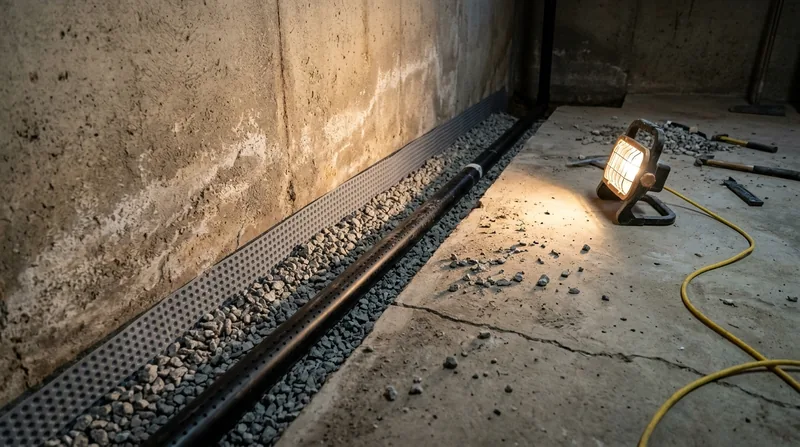
We install interior perimeter drain tile beneath the slab edge, channel the water to a sump basin, and pump it out. This is the proven year-round answer for the Fox Valley's dense clay, and it works in any season. Unlike exterior excavation, we do not dig up your yard or disturb mature oaks and river cottonwoods. For a broader look at how this fits with other solutions, see our basement waterproofing service.
Why Aurora Homes Need Interior Drain Tile: From Victorian Stone to Modern Poured Concrete
Aurora's building stock is a catalog of foundation types, and each one fails differently. The 1860s-1910s Victorians and Italianates in Tanner and Near Westside sit on cut limestone or brick from Fox Valley quarries. Those mortar joints erode and let water seep. The 1910s-1940s brick bungalows and foursquares on full basements often have no drain tile at all. The 1950s-1960s brick ranches and split-levels on concrete block basements across the east and west sides wick water through the block cores. And the 1990s-2020s two-story homes on the Far East Side have deep poured-concrete basements that crack under hydrostatic pressure.
In every case, the failure mode is the same: water in the basement after rain, efflorescence on the walls, a musty basement smell, or a sump pump that runs nonstop and eventually fails. Here is what we see most often:
- Hydrostatic pressure pushes water through cove joints and floor cracks in older stone and brick foundations.
- Failed or missing footing drains let water pool against the foundation instead of draining away.
- High water table in former wetlands and creek corridors keeps the soil saturated long after the rain stops.
- Sump pump failure during spring snowmelt or a heavy summer storm turns a wet basement into a flooded one.
Interior drain tile addresses all four by intercepting water at the lowest point and moving it out mechanically.
Key info: In North Aurora and Montgomery, we routinely find 1950s block basements with original weep holes that are completely clogged with clay silt. The wall looks dry until a three-inch rain, then water sheets across the floor within an hour.
For official guidance on floodplain and water table conditions in the area, the City of Aurora publishes local resources, and we always recommend verifying current rules with the building department.
How We Install an Interior Drain Tile System in Aurora, Step by Step
We start with a free basement inspection to confirm the water source. Sometimes a simple crack repair is enough. When the problem is hydrostatic pressure or a failed footing drain, interior drain tile is the better answer than exterior excavation. Here is our process:
- We break and remove a 12- to 16-inch strip of slab along the perimeter wall.
- We dig down to the footing and shape the trench so water flows by gravity to the sump basin.
- We lay perforated drain tile in washed gravel, wrapped in filter fabric to keep clay fines out.
- We set a sump basin at the low point and connect it to the drain tile with a check valve.
- We install a sump pump and discharge line that moves water well away from the foundation.
- We pour new concrete over the trench and leave the floor clean and level.
The job is finished with a gravity-fed system that works whether the pump runs or not, and we test it before we leave.
Key info: On a 1920s foursquare in Pigeon Hill, the original brick footing was three courses below the slab. We had to hand-dig the last 18 inches to avoid disturbing the limestone. The homeowner had water after every rain for 12 years. One day of work solved it.
If your existing drain tile is collapsed or clogged, we also handle drain tile repair and replacement.
Comparing Interior Drain Tile Approaches for Aurora Basements
Not every basement needs the same configuration. The table below shows the main approaches we use and when each one makes sense for Aurora's foundations and water conditions.
| Approach | Description | Best for |
|---|---|---|
| Full interior perimeter drain tile | Continuous gravel trench with perforated pipe along all walls, tied to a sump basin. | Hydrostatic pressure on all sides, wet basement after rain, older stone or block foundations. |
| Partial drain tile (one or two walls) | Drain tile along the wet wall only, usually the uphill or river-facing side. | Isolated seepage, budget-conscious projects, homes on a slope. |
| Drain tile with dimple board | Drain tile plus a dimple board membrane against the wall to direct water down. | Block walls that wick water, efflorescence, musty basement smell. |
| Drain tile plus vapor barrier | Full system with a sealed vapor barrier over walls and floor. | High water table, finished basements, moisture control and prevention of mold growth. |
| Drain tile with battery backup sump pump | Full system with a battery backup pump for power outages. | Homes that flood during storms, spring snowmelt, frequent power loss. |
Interior Drain Tile System Cost in Aurora: What to Expect
Most interior drain tile systems in Aurora start at From $50 per linear foot. That figure includes breaking and removing the slab, digging to the footing, gravel, perforated pipe, filter fabric, and new concrete. A typical 100-linear-foot basement perimeter runs $5,000 to $7,500. The main factors that move the price are foundation type (cut limestone is slower to work than poured concrete), access (tight gangways and finished basements add labor), and whether you need a new sump basin or pump.
We always recommend getting two or three estimates. A contractor who quotes without opening the floor or checking the footing may be guessing. For a detailed breakdown of what each component costs, see our full pricing overview.
What to Look for When Hiring an Interior Drain Tile System Contractor Near Aurora
Hiring the right contractor matters more than the brand of pipe. Here is what we tell homeowners to check before signing anything.
- Confirm the contractor is licensed and insured, and ask for a certificate of insurance before work starts.
- Get at least three written estimates that specify the linear footage, pipe type, and sump pump model.
- Ask for local references from Aurora or North Aurora and call them, not just read the reviews.
- Ask whether the work requires a permit from the City of Aurora building department, and who pulls it.
- Check for a transferable warranty in writing, and read what it actually covers.
We are a Basement Health Association (BHA) member and carry full insurance. You can contact us for a free estimate and we will walk you through the process without pressure.
Interior Drain Tile System in Aurora: Pricing Guide
| Service | Price | Details |
|---|---|---|
| Full interior perimeter drain tile | From $50/linear ft | Includes slab removal, gravel trench, perforated pipe, filter fabric, and new concrete; price rises with foundation type and access. |
| Partial drain tile (one or two walls) | From $45/linear ft | Covers the wet wall only; cost depends on whether the wall is block, brick, or poured concrete. |
| Drain tile with sump basin and pump | From $1,200 additional | Includes new sump basin, check valve, and pump; higher for battery backup or cast-iron pump models. |
| Complex or large-scale job | On estimate | Finished basements, cut limestone footings, or tight access need an on-site look before we quote a number. |
| Travel | Included | in Aurora and surrounding areas, no separate call-out or mileage fee. |
| Estimate | Free | Response within 24h at (331) 210-0522, no obligation to book. |
Indicative pricing, the exact cost depends on square footage, finish, and site access. Free personalized estimate within 24h at (331) 210-0522.


